
A managing director CV should do more than sound senior.
It should show that you have led a business, division or country operation with real commercial accountability. That means making it easy for the reader to see the scale of your remit, the decisions you were trusted to make, the stakeholders you had to manage, and the results you delivered.
For most MD-level roles, employers are not looking for a polished list of responsibilities. They want evidence that you can take ownership of performance, lead through complexity, make sound commercial decisions and operate credibly with boards, shareholders, regulators, clients and internal leadership teams.
That is why a strong managing director CV usually needs to prove five things quickly:
- you have owned or influenced revenue, margin, budgets or broader P&L outcomes
- you can translate strategy into execution
- you understand governance, risk and accountability
- you have led at scale across people, operations or regions
- you can deliver measurable business outcomes, not just activity
This is especially important if you are targeting MD roles in South Africa, where senior leadership hiring often places close attention on judgement, credibility, stakeholder management and the ability to lead within a governance-conscious environment. A CV at this level should therefore read like an executive business case, not a longer version of a middle-management CV.
If your current CV sounds experienced but does not yet make your commercial and leadership value obvious, you can get a free CV review for confidential feedback on what it is and is not signalling.
Where candidates often go wrong is that they write for title recognition rather than decision-maker scrutiny. “Managing Director” on its own does not carry the page. The CV still has to show the business context behind the title: what you ran, what changed under your leadership, what scale you handled, and what improved because of your decisions.
That is also why many senior candidates benefit from approaching the document as a positioning tool rather than a record of everything they have done. A well-written MD CV should help a recruiter, board, investor-backed business or executive search consultant understand not only where you have worked, but what kind of enterprise leader you are.
If you already know you need a more strategic rewrite rather than light editing, you can explore the firm’s CV writing service for more tailored support.
In the sections that follow, this guide will show you how to position an MD CV for South African and international opportunities, what to include, what to leave out, and how to make your achievements sound commercially credible at executive level.
What is a Managing Director CV?
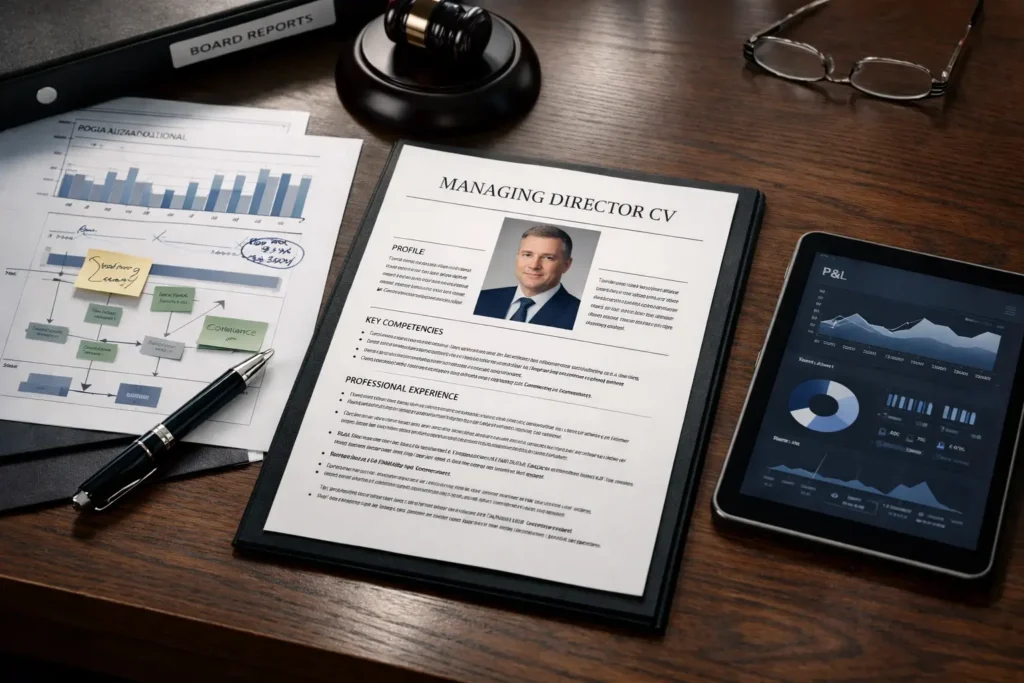
A managing director CV is a senior leadership CV built to show commercial accountability, strategic execution, governance awareness and leadership at scale. It should make it clear that you have operated beyond functional management and have been trusted to lead performance, people, risk, stakeholders and business outcomes at enterprise, regional or country level.
In other words, this is not just a more senior-looking CV.
A strong MD CV should show that you can lead a business or major division with real commercial responsibility. That usually means demonstrating ownership or influence over revenue, margin, cost optimisation, operational performance, strategic delivery, stakeholder confidence and measurable growth or turnaround outcomes.
If you are targeting a broader range of senior leadership roles as well, you may also find it helpful to read this guide on how to write an executive CV. That article covers wider executive CV principles, while this page focuses specifically on what a managing director CV needs to communicate.
Who this guide is for
This guide is especially useful if you are:
- applying for a Managing Director role in South Africa
- moving from General Manager into an MD-level position
- targeting a Country Manager role with full commercial accountability
- leading a business unit, division or regional operation and stepping into broader enterprise leadership
- applying for CEO roles in smaller firms where the brief overlaps significantly with an MD mandate
- using one senior leadership CV to support both local and international applications
It is also relevant if your current title does not yet say “Managing Director”, but your responsibilities already include business leadership, P&L ownership, transformation, board reporting, regulatory exposure or high-level stakeholder management.
That matters because many candidates are closer to MD-level work than their current title suggests. In those cases, the CV needs to position the scope of the role clearly, rather than relying on the title alone to do the work.
What makes a managing director CV different?
A managing director CV should place more weight on business leadership than a general senior CV.
That means the document should quickly answer questions such as:
- What size business, function or geography were you leading?
- What commercial outcomes were you responsible for?
- What changed under your leadership?
- Who did you influence or report to?
- How complex was the stakeholder environment?
- What evidence is there that you operated at MD level rather than simply holding a senior title?
At this level, employers are usually looking for signs of judgement as much as experience. They want to see that you can lead through complexity, balance competing demands, make commercially sound decisions and communicate credibly with internal and external stakeholders.
That is why a managing director CV should feel focused, selective and outcome-led. It should not try to document everything. It should make a convincing case for your readiness to lead at enterprise or country level.
If you are unsure whether your current CV is signalling that level of leadership clearly enough, you can get a free CV review and get feedback on how it is likely to land with decision-makers.
Managing Director CV vs Executive CV vs CEO CV

These titles often overlap in practice, which is exactly why the CV has to do more than repeat the job title.
A managing director CV sits within the wider executive-CV category, but it usually needs a sharper operating and commercial emphasis. In most cases, it should make it easy for the reader to see that you have run a business, country operation, division or major profit centre with real responsibility for performance, people, stakeholders and results. In the South African context, that seniority also tends to sit inside a more visible governance and accountability environment, which makes judgement, board credibility and director-level responsibility more important signals on the page.
An executive CV, by contrast, is the broader umbrella. It can be used for a range of senior roles, including Managing Director, Operations Director, Commercial Director, Country Manager, Executive Head or C-suite appointments. If you are targeting a wider senior leadership market rather than a clearly defined MD brief, this guide on how to write an executive CV is the better starting point.
A CEO CV usually pushes even further towards enterprise leadership, market direction, investor or board confidence, external visibility and top-level strategic stewardship. In smaller firms, the line between MD and CEO can be thin. In larger organisations, however, the MD brief is often more tightly tied to operating performance, execution and business-unit or country accountability, while the CEO brief is more enterprise-wide and externally weighted.
When an MD CV needs a different emphasis
If you are applying specifically for Managing Director roles, the CV should usually lean harder into:
- commercial ownership and P&L accountability
- strategy translated into operational delivery
- leadership across functions, markets or regions
- governance, risk and executive judgement
- stakeholder management across boards, shareholders, regulators, workforce groups and key clients
- measurable business outcomes under your leadership
That is the key difference. A general executive CV can sometimes stay broader. A managing director CV usually needs to feel closer to the commercial engine of the business.
Managing Director CV vs Executive CV vs CEO CV
| Document type | Best used for | Main emphasis | What must be obvious | Common mistake |
|---|---|---|---|---|
| Managing Director CV | MD, General Manager to MD, Country Manager, division or business-unit leadership roles | Commercial accountability, operating leadership, strategic execution, stakeholder and governance credibility | P&L scope, business scale, board or senior stakeholder exposure, measurable results, leadership complexity | Sounding senior without showing what was actually led, improved or owned |
| Executive CV | Broad senior leadership market across multiple titles | Transferable executive capability, leadership profile, strategic contribution, cross-functional value | Seniority, leadership breadth, progression, impact, relevance across more than one target role | Being too broad or generic when applying for a highly specific MD brief |
| CEO CV | CEO roles, founder-led scale-up leadership, enterprise leadership mandates | Vision, enterprise performance, investor/board leadership, market direction, top-of-house strategy | Organisation-wide leadership, market-facing credibility, enterprise stewardship, strategic narrative | Writing an aspirational strategy document without enough operational proof |
This distinction matters because many candidates inadvertently send the wrong signal. A CV can be strong and still miss the mark if it reads like a broad executive profile when the employer really wants proof of business leadership, operating scale and commercial accountability.
For example, if your current CV talks about “leading teams”, “driving strategy” and “improving performance”, but does not clearly show revenue responsibility, margin improvement, restructuring, board interaction, multi-site operations or business turnaround outcomes, it may read as senior but not distinctly MD-level.
A useful rule is this:
- if the target role is broad and flexible across several executive paths, a general executive CV may be enough
- if the target role is clearly MD-focused, the CV should feel more commercial, more accountable and more closely tied to business performance
- if the role is CEO-focused, the document usually needs a wider enterprise and market narrative
In South Africa, that MD-level credibility is strengthened when the CV signals not just commercial leadership, but also maturity around governance, accountability and high-level decision-making. That does not mean quoting legislation or writing in boardroom jargon. It means showing that you have operated in environments where director duties, risk oversight and stakeholder confidence genuinely mattered.
The 10-point managing director CV checklist

Before you worry about wording, formatting or polish, it helps to ask a simpler question: does your CV actually prove MD-level value?
That matters because senior CVs are usually screened quickly at first. A recruiter or hiring decision-maker will often look for clear signals of fit before deciding whether to read more closely, which makes structure, hierarchy and front-loaded relevance especially important.
Use the checklist below as a practical test.
If you can answer “yes” to most of these points, your CV is likely moving in the right direction. If not, the issue is usually not experience. It is how that experience is being positioned on the page.*
10-point managing director CV checklist
- Is your target position clear near the top?
The first section should make it obvious that you are targeting Managing Director, MD-equivalent or broader enterprise leadership roles. Do not leave the reader guessing whether you are a senior functional leader or a business leader. - Does the CV show commercial ownership?
A strong MD CV should make it clear whether you owned or materially influenced revenue, margin, cost control, profitability, budgets or broader P&L outcomes. - Have you shown strategy and execution together?
It is not enough to say you “developed strategy”. At this level, employers want to see that strategy turned into measurable business results. - Is there clear evidence of scale?
Your CV should show the size and complexity of what you led. That may include headcount, regional footprint, business unit size, customer base, operating budget, capital budgets or number of sites. - Have you made governance, risk or compliance visible?
An MD CV should usually signal that you operated with accountability, judgement and oversight, especially if your remit involved regulated environments, board reporting, risk management or governance responsibilities. - Does stakeholder management look senior enough?
At MD level, stakeholder language should go beyond “worked cross-functionally”. It should reflect board interaction, shareholder reporting, executive committee leadership, regulator engagement, client stewardship, workforce relations or union engagement where relevant. - Are your bullets outcome-led rather than responsibility-led?
Generic statements such as “responsible for operations” or “oversaw multiple teams” rarely create enough impact. The better question is: what changed, improved, grew, stabilised or transformed under your leadership? - Have you included turnaround, restructuring or transformation work where relevant?
Many MD appointments are made because a business needs growth, integration, change, recovery or operating model improvement. If that is part of your background, it should be visible. - Have you handled confidentiality properly?
Senior candidates often undersell themselves because the strongest examples involve sensitive commercial information. You do not need to disclose everything. You do need to show the scale, context and outcome in a way that remains credible and discreet. - Is the layout clean, readable and ATS-friendly?
Even at executive level, readability still matters. A cluttered CV with weak headings, dense paragraphs and poor hierarchy makes it harder for someone to spot the signals that matter. If you need a refresher on keeping the document ATS-safe, this guide to ATS-optimised CV writing is worth reviewing.
What a strong result looks like
A strong managing director CV should let the reader identify the following within the first page or two:
- the type of business or mandate you have led
- the commercial outcomes you influenced
- the scale and complexity of your remit
- the senior stakeholders you engaged with
- the strategic or operational changes you delivered
- the results that make you credible for another MD-level appointment
If too many of those points are buried, implied or missing, the CV may still look senior but fail to feel commercially decisive.
That is often the difference between a document that gets shortlisted and one that gets politely overlooked.
If you want an external view on whether your current document is making those signals obvious enough, you can get a free CV review and assess where the gaps are before you start rewriting from scratch.
The structure of a strong managing director CV
The structure of a managing director CV matters because it shapes what the reader understands first.
At MD level, most decision-makers are not trying to absorb your entire career in one pass. They are looking for fast proof of fit: your level, your commercial scope, the kind of business problems you have solved, the stakeholders you have handled and the results you have delivered. That makes hierarchy, sequencing and clarity especially important. Eye-tracking research from Ladders found that recruiters tend to focus on a relatively small set of areas during an initial scan, which is one reason clear layout, obvious headings and front-loaded relevance matter so much.
A strong managing director CV does not need gimmicks. It needs structure.
In most cases, the best approach is to organise the document so that the first page answers the most commercially important questions quickly, while the rest of the CV adds depth and supporting evidence.
Recommended managing director CV section order
A practical MD CV structure usually looks like this:
- Name and contact details
- Executive headline
- Positioning summary
- Selected achievements or impact snapshot
- Core leadership strengths
- Professional experience
- Education and qualifications
- Board, advisory or additional relevant appointments
- Optional extras such as languages or international mobility, where relevant
This order works because it puts strategic context and commercial proof before detail-heavy chronology. That is usually the right balance for a senior leadership reader who wants to understand your level before committing to a full read.
Executive headline and positioning statement
The headline should quickly establish the level at which you operate.
This does not need to be clever. It needs to be clear.
For example, a headline might position you as:
- Managing Director | Commercial Growth | Turnaround | Multi-Site Leadership
- Managing Director | P&L Ownership | Strategy Execution | Operational Transformation
- General Manager / Country Leader | MD-Level Commercial and Operational Leadership
The summary beneath that should then explain, in a few short lines, what kind of executive you are. At this level, the strongest summaries usually combine:
- sector or market context
- commercial scope
- leadership style or strengths
- types of mandates handled
- measurable business outcomes or signature themes
A good summary should not read like a list of adjectives. It should sound like a concise explanation of the kind of business leader you are and the value you bring.
Impact snapshot or selected achievements
This is one of the most useful sections on an MD CV because it gives the reader immediate evidence.
Instead of making them dig through your career history to work out whether you have led growth, turnaround, integration, restructuring or transformation, you surface the strongest proof near the top.
This section can work well as 4–6 short bullets highlighting outcomes such as:
- revenue growth delivered over a defined period
- margin or profitability improvement
- cost optimisation or operating model redesign
- successful turnaround of an underperforming business unit
- regional expansion or new-market entry
- board-facing transformation or restructuring programme
If you already know your top section is underpowered, you can get a free CV review to identify which signals are landing clearly and which are still too buried.
Core leadership strengths
This section should help the reader see the themes that run through your leadership profile.
At MD level, these are usually not entry-level skills or software terms. They are more likely to be capabilities such as:
- P&L leadership
- commercial strategy
- turnaround and restructuring
- operational excellence
- governance and risk oversight
- board and shareholder engagement
- stakeholder management
- multi-site or cross-border leadership
- transformation delivery
- revenue growth and margin improvement
Keep this section selective. It should reinforce your positioning, not try to cover everything you have ever done.
Professional experience with scope lines
This is where many senior CVs become too generic.
Each role should begin with a short scope line that tells the reader what you were actually leading. That may include:
- size of the business unit, division or country operation
- revenue, budget or P&L responsibility
- headcount or leadership span
- number of sites, markets or regions
- reporting line
- strategic mandate, such as turnaround, growth, integration or expansion
That context matters because it helps your achievements make sense. A bullet about improving profitability means far more when the reader understands the size, complexity and mandate of the operation you were leading.
After the scope line, focus your bullets on outcomes, not task lists.
A strong MD career-history entry typically shows:
- what the situation was
- what you led or changed
- what the result was
- why it mattered commercially or strategically
If your experience is broad and you are struggling to decide what to keep or cut, professional CV writing support can be especially useful at this level because the challenge is often prioritisation rather than lack of content.
Education, qualifications and board or advisory roles
For many MD candidates, this section carries more weight than it would in a mid-level CV, especially where qualifications, executive education, governance credentials or industry-specific certifications support credibility.
Include formal education, relevant executive programmes and significant professional memberships where they strengthen your case.
If you have held board, advisory, trustee or non-executive roles that reinforce your leadership profile, include them as well. These appointments can add useful context around governance exposure, judgement and strategic breadth.
Optional extras that may add value
Not every MD CV needs an extra section, but some candidates benefit from including one if it supports the target brief.
Possible additions include:
- languages
- regional or international mobility
- cross-border market exposure
- sector specialisms
- public-speaking or media credibility, if relevant to the role
- selected M&A, post-merger integration or investor-facing exposure, where appropriate
Only include these if they add signal. They should not dilute the core commercial narrative.
What to avoid in the structure
A managing director CV is usually weakened when:
- the first page is filled with generic profile language instead of proof
- the document opens with long paragraphs and no visible hierarchy
- achievements are buried beneath duties
- business scale is left implied rather than stated
- every role is written at the same level of detail
- older, less relevant experience takes up too much space
- the layout becomes overly designed and harder to scan
That is why a clean, readable structure still matters, even for highly senior candidates. The document should help the reader locate the most decision-relevant information quickly, not work hard to decode it.
If your LinkedIn profile is also part of your search strategy, it helps to keep the positioning consistent across both documents. This is where tailored LinkedIn profile writing support can help reinforce the same leadership narrative.
What employers expect to see in an MD CV
At managing director level, employers are usually reading for evidence of enterprise leadership rather than seniority alone.
They want to see whether you have led performance, not simply participated in it. They want to understand the size and complexity of the operation, the commercial stakes involved, the stakeholders you had to balance, and the results you delivered under pressure. In South Africa, that expectation also tends to sit inside a more explicit governance and director-accountability environment, which makes judgement, oversight and credibility more important signals on the page.
A strong MD CV should therefore make six things easy to spot.
Commercial ownership
One of the clearest signals is commercial accountability.
That can include responsibility for revenue, margins, profitability, cost optimisation, cash discipline, pricing, budgets or wider P&L performance. Even where you were not the sole owner of the numbers, the CV should still show how your decisions influenced commercial outcomes.
This is where many senior CVs underperform. They say “led the business” or “oversaw operations” but never make the financial impact clear enough. At MD level, employers usually want to know what scale you handled and what improved under your leadership.
Strategy execution and operating model change
Senior employers are rarely persuaded by strategy language on its own.
Most MD briefs are not simply about setting direction. They are about turning direction into execution. That means showing how you translated strategy into delivery, growth, stabilisation, restructuring, integration, market entry, service improvement or operating model change.
A useful question to test each bullet against is this: does it show that you shaped business outcomes, or just that you attended senior meetings?
Governance, risk and compliance awareness
At this level, employers also expect to see signs of mature judgement.
You do not need to turn the CV into a governance paper. But it should be clear if your remit involved board reporting, audit or risk oversight, regulatory engagement, policy accountability, compliance leadership or operating in a highly governed environment. That matters because South African corporate governance expectations remain a visible part of director-level leadership, with King V now replacing King IV for financial years beginning on or after 1 January 2026, and CIPC explicitly highlighting the consequences of non-compliance with directors’ duties.
In practical CV terms, that means governance should be visible through the way you describe your scope and decisions, not through abstract claims such as “good corporate governance”.
Stakeholder management at the right level
An MD CV should also show that you can lead in a complex stakeholder environment.
That may include boards, shareholders, executive committees, regulators, major clients, lenders, workforce groups, unions or strategic partners. The important point is not to mention every possible stakeholder. It is to make it obvious that you have operated at a level where influence, judgement and communication mattered commercially.
Generic wording such as “worked cross-functionally” is usually too weak for this level. Employers want to see that you managed upward, outward and across the business.
Leadership scale and organisational complexity
Scope matters.
A managing director CV becomes more credible when it shows the size and complexity of what you led. Depending on your background, that may include:
- headcount or leadership span
- number of sites, countries or regions
- operating budget or capital budget
- revenue footprint or portfolio size
- customer or client base
- level of organisational change or turnaround required
Without that context, even strong achievements can feel smaller than they really were.
Turnaround, transformation and measurable outcomes
Many MD appointments are made because something needs to change.
That may mean growth, margin recovery, restructuring, expansion, post-merger integration, service improvement, digital transformation or leadership stabilisation. If you have done that work, it should not be buried.
The strongest MD CVs do not simply say what the role covered. They show what moved because of your leadership.
What to show and how to prove it
| What employers want to see | How to prove it on the CV |
|---|---|
| Commercial accountability | State revenue, budget, margin, profitability or cost mandate where possible |
| Strategic leadership | Show what strategy you executed and what changed as a result |
| Governance maturity | Reference board reporting, risk oversight, regulatory exposure or compliance accountability where relevant |
| Stakeholder credibility | Name the level of stakeholders you worked with, such as board, shareholders, regulators or key clients |
| Leadership scale | Add headcount, regions, sites, budgets or business-unit scope |
| Transformation capability | Show turnaround, restructuring, integration or operating model change with measurable outcomes |
This is also where achievement-led writing becomes essential. If your CV still reads mostly as a list of responsibilities, it may undersell you even if your background is strong. For more on turning senior duties into stronger evidence of impact, see this guide on how to highlight skills and achievements in a CV.
A useful rule of thumb is that every major section of an MD CV should answer one of these questions:
- What did you lead?
- How big or complex was it?
- What changed under your leadership?
- Why did that matter commercially or strategically?
If too many bullets fail that test, the CV will often sound experienced but not decisive.
Before-and-after bullet rewrites for managing director CVs

One of the fastest ways to strengthen a managing director CV is to rewrite responsibility-led bullets so they sound more commercial, more specific and more senior.
At this level, the problem is rarely lack of substance. It is usually that the CV describes the role, but not the value you brought to it.
A weak MD bullet tends to do one of three things:
- it lists duties instead of outcomes
- it sounds senior but vague
- it hides the scale, stakes or business result
A stronger MD bullet does the opposite. It shows what you led, what changed, and why that mattered.
What stronger MD bullets usually include
The best bullet points at this level often combine some of the following:
- the commercial or strategic problem
- the scope of your remit
- the action you led
- the measurable result
- the business significance of that result
That does not mean every bullet needs to include five separate data points. It means each bullet should earn its place.
Below are examples of how to make that shift.
Before-and-after examples
| Before | After | Why the rewrite works |
|---|---|---|
| Responsible for overall business performance and operations. | Led full P&L, operational and strategic performance for a multi-site business unit, improving EBITDA margin by 5.8 percentage points over 24 months through pricing discipline, cost reset and operating model redesign. | The rewrite shows ownership, scope, timeframe and commercial outcome. |
| Managed a large team across different departments. | Directed a cross-functional leadership team of 9 and an overall workforce of 420 across operations, sales, finance and supply chain, stabilising performance during a period of restructuring and leadership change. | The rewrite adds leadership scale, complexity and business context. |
| Developed and implemented growth strategies. | Designed and executed a three-year growth plan that increased revenue by 27%, expanded the customer base into two new regional markets and improved gross margin through tighter commercial governance. | The rewrite connects strategy to measurable commercial delivery. |
| Worked closely with the board and senior stakeholders. | Reported to the board on business performance, risk exposure and strategic priorities, while leading engagement with shareholders, key clients and external partners during a major transformation programme. | The rewrite shows the level of stakeholder engagement and why it mattered. |
| Oversaw a transformation project across the business. | Led end-to-end transformation of the operating model across five business units, reducing duplication, improving decision-making speed and delivering annualised cost savings of R18 million. | The rewrite turns a generic project reference into a business-impact statement. |
| Helped improve profitability. | Repositioned the commercial and operational model of an underperforming division, restoring profitability within 18 months and returning the business to sustainable growth. | The rewrite sounds more decisive and commercially credible. |
Example rewrites by theme
Revenue and commercial growth
Weak:
- Responsible for driving sales growth across the business.
Stronger:
- Led commercial growth strategy across a national business portfolio, increasing annual revenue by 19% through pricing refinement, channel expansion and improved sales-execution discipline.
Why it works:
It moves from generic intent to specific commercial impact.
Margin improvement and cost optimisation
Weak:
- Improved cost control and business efficiency.
Stronger:
- Reset the cost base and introduced tighter operational controls, improving operating margin by 4.2 percentage points without weakening customer delivery or workforce stability.
Why it works:
It sounds more MD-level because it shows balance, not just cuts.
Turnaround and recovery
Weak:
- Managed a business turnaround.
Stronger:
- Appointed to stabilise an underperforming business unit and led a 12-month turnaround that improved service delivery, restored stakeholder confidence and returned the operation to profit.
Why it works:
It explains the situation, the mandate and the result.
Stakeholder management
Weak:
- Maintained relationships with internal and external stakeholders.
Stronger:
- Led engagement with board members, regulators, union representatives and strategic clients during a high-pressure restructuring period, helping maintain continuity, reduce risk exposure and preserve commercial confidence.
Why it works:
The level of stakeholder complexity is finally visible.
Transformation and change delivery
Weak:
- Implemented strategic change initiatives.
Stronger:
- Delivered a group-wide operating model change programme spanning people, systems and governance, improving accountability, reducing duplication and strengthening execution across multiple business units.
Why it works:
It sounds like business leadership rather than internal project support.
International or regional exposure
Weak:
- Managed regional expansion.
Stronger:
- Directed expansion into three African markets, establishing local leadership capability, strengthening market entry execution and building a more diversified regional revenue base.
Why it works:
It signals growth, reach and execution capability.
A simple formula for stronger MD bullets
A useful formula is:
Led, what and at what scale, and to achieve what result
For example:
- Led turnaround of a multi-branch operation serving a national client base, restoring profitability and improving retention within 12 months.
- Directed integration of two business units with combined headcount of 300+, improving operating efficiency and creating a more scalable leadership structure.
- Owned strategic and commercial delivery for a regional portfolio, increasing revenue, strengthening margin and improving board confidence in execution.
This formula is not something to apply mechanically to every bullet, but it is a good way to test whether a statement is doing enough work.
What to avoid when rewriting MD bullets
Be careful not to make the bullet stronger by simply making it longer.
The aim is not more words. It is better signal.
Avoid:
- vague verbs such as “assisted”, “helped” or “involved in” where you actually led
- empty leadership language such as “dynamic”, “results-driven” or “strategic thinker” without proof
- inflated claims that sound impressive but cannot be supported
- dense bullets that bury the result
- overuse of confidential detail that should be anonymised or generalised
If your CV still sounds duty-heavy after a rewrite, it may help to revisit how you frame achievements more broadly. This guide on highlighting skills and achievements in a CV may help, especially if you have strong experience but are struggling to express it sharply.
And if the challenge is less about wording and more about how to position the whole document at MD level, you may be better served by tailored CV writing support.
South African realities: governance, confidentiality and hiring nuance

A managing director CV written for the South African market should not just sound commercially strong. It should also reflect the level of judgement expected of someone operating in a director-level environment.
That does not mean filling the page with governance jargon.
It means showing, in a credible and restrained way, that you have led in contexts where accountability, oversight, stakeholder confidence and risk awareness genuinely mattered. That is particularly relevant in South Africa, where the governance backdrop is visible and current: IoDSA states that King V was released on 31 October 2025, supersedes King IV, and is effective for financial years beginning on or after 1 January 2026. CIPC has also issued Guideline 1 of 2025 to sensitise directors to the consequences of non-compliance with their duties.
For your CV, the practical takeaway is simple: an MD document should not read as though leadership happened in a vacuum. It should make it clear that you operated with commercial accountability, decision-making responsibility and a mature understanding of risk, governance and stakeholder consequences.
Why governance awareness matters on an MD CV
Employers do not normally expect a managing director CV to quote legislation or governance codes directly.
They do, however, expect signs that you understand what responsible leadership looks like at this level. In practice, that may show up through references to:
- board reporting or board-facing leadership
- audit, risk or compliance oversight
- regulatory engagement
- policy and governance accountability
- ethical decision-making in complex environments
- leadership during periods of restructuring, investigation, turnaround or heightened scrutiny
That matters because a managing director is rarely judged only on growth. The role is also judged on how that growth is led, governed and sustained. South African boards and employers are especially unlikely to be impressed by a CV that sounds commercially aggressive but makes oversight, accountability and risk awareness invisible.
A better approach is to let governance maturity appear through the examples you choose. For example, a bullet about leading a transformation programme becomes stronger when it also shows board reporting, regulatory complexity, risk control or stakeholder alignment where those elements genuinely formed part of the brief.
How to reference sensitive work without oversharing
Many senior candidates have a real problem at this level: their most impressive work is often commercially sensitive.
That may include turnaround mandates, restructuring, shareholder negotiations, margin recovery, confidential client relationships, M&A activity, pricing interventions, workforce negotiations or regulator-facing issues. The answer is not to remove that work from the CV altogether. The answer is to describe it with enough signal and not too much exposure.
A useful rule is to protect the detail, not the value.
For example, instead of naming a confidential programme, exact counterparties or highly sensitive internal terminology, you can often say:
- “led turnaround of an underperforming division”
- “reported to the board during a high-pressure restructuring programme”
- “stabilised operations and restored profitability in a regulated environment”
- “led stakeholder engagement during a major operating model reset”
- “oversaw a confidential strategic review that reshaped the commercial footprint”
That still communicates seniority, judgement and scope without disclosing what should stay private.
If you are unsure whether your current wording is too vague or too exposed, you can get a free CV review and sense-check the balance before you start sending the document out.
POPIA-aware confidentiality: what to anonymise and what to generalise
This is one of the clearest South African distinctions.
The Information Regulator states that it monitors and enforces compliance with POPIA for public and private bodies, and its POPIA guidance also notes that public and private bodies are required to register Information Officers, while section 55 sets out duties that include encouraging compliance with the conditions for lawful processing of personal information.
You are not expected to turn your CV into a POPIA document. But you should write with the kind of discretion that would be expected of a senior leader operating in a privacy- and compliance-aware environment.
In practical terms, that usually means being careful with:
- names of confidential clients, suppliers or counterparties
- personally identifiable employee or customer information
- highly specific internal investigation details
- non-public commercial data that could create risk if disclosed
- sensitive regulatory or disciplinary matters that do not belong in a marketing document
In many cases, it is better to generalise the context while preserving the business significance.
For example:
- instead of naming a confidential client, refer to “a major national client account”
- instead of disclosing a highly sensitive project title, describe “a group-wide restructuring programme”
- instead of exposing granular personal or workforce data, refer to “a workforce of 600+ across multiple sites” where appropriate
That keeps the CV credible while showing sound judgement.
When workforce, union or regulator exposure belongs on the page
Some candidates worry that mentioning regulators, workforce complexity or union engagement will make the CV sound defensive.
Usually, the opposite is true.
If those elements were a real part of your MD remit, they often strengthen the document because they signal that you led in a more complex operating environment. The key is to keep the wording executive and commercially relevant.
For example, these can add value when they show that you:
- maintained continuity during a period of regulatory scrutiny
- led workforce or union engagement during operational change
- balanced service delivery, cost discipline and stakeholder stability
- managed risk in a heavily governed or regulated sector
- preserved client or shareholder confidence during disruption
That kind of experience often makes a managing director CV more convincing, not less.
How to show seniority without breaching confidentiality
Use this quick test before finalising the page.
- Name the scale without naming what is private
- Show the mandate without exposing confidential strategy
- Demonstrate the result without over-disclosing protected numbers
- Reference stakeholder complexity without turning the CV into a case file
- Keep the language calm and factual rather than dramatic
If you do that well, the CV will usually feel more senior.
Why? Because discreet writing is itself a sign of judgement. Employers hiring at MD level often notice when a candidate knows how to communicate value without losing discipline.
If you are weighing up whether now is the right time to get outside help, this guide to choosing the best CV writing company in South Africa may help you assess what credible executive support should look like.
How to tailor your MD CV for local and international roles

Many South African executives use one core CV to support several types of application.
That might mean applying for Managing Director roles locally while also targeting Country Manager, General Manager or CEO positions in multinational businesses, regional groups or offshore markets. In principle, that is fine. In practice, the CV usually works best when you treat it as a strong master document and then adjust the positioning for each opportunity.
At MD level, tailoring does not usually mean rewriting everything. It means changing emphasis.
Start with a strong core version
Your base CV should already communicate the essentials:
- the scale of what you have led
- your commercial and operational accountability
- the strategic and transformation work you have delivered
- the stakeholder complexity you have handled
- the measurable business outcomes that make you credible at MD level
Once that foundation is in place, tailoring becomes much easier. You are no longer trying to invent relevance. You are simply deciding which parts of your leadership story deserve the strongest emphasis for a particular role.
When to use “CV” and when to use “resume”
For South African applications, “CV” is the more natural term.
For international applications, especially where the employer explicitly asks for a resume, it can make sense to adjust the label and tighten the presentation slightly. In many cases, though, the bigger issue is not the word at the top of the page. It is whether the document is focused enough for that specific market, company or brief.
A useful working rule is:
- use CV for South African roles and where the employer uses that language
- use resume where the employer clearly asks for one
- keep the substance executive, selective and commercially sharp either way
If the underlying content is strong, the label is usually a secondary detail.
What to adapt for multinational or offshore roles
When you are applying internationally, the main job is often to make your experience easier for an external reader to understand.
That may mean:
- reducing local jargon or company-specific shorthand
- clarifying the scale of the business or division you led
- explaining acronyms that may not travel well
- making market, geographic or regulatory context clearer where needed
- drawing more attention to regional, cross-border or multinational exposure
For example, a South African employer may immediately understand the context behind a local brand, sector nuance or regulatory environment. An overseas reader may not. In those cases, it helps to describe the business in plain terms rather than assuming recognition.
Instead of relying on the company name alone, you might clarify:
- whether it was a listed, private, investor-backed or family-owned business
- the size of the operation
- the geographic footprint
- the core commercial model
- the mandate you were brought in to deliver
That kind of context helps an international reader assess your level quickly.
How to handle local company names, acronyms and market context
A good MD CV should not force the reader to decode your background.
If you have worked in businesses, sectors or structures that are highly recognisable in South Africa but less obvious elsewhere, make the context easier to grasp. That does not mean over-explaining every employer. It simply means adding enough information for the reader to understand the scale and nature of the role.
For example, this may involve:
- expanding acronyms on first use
- adding a short company descriptor in brackets
- clarifying whether a division was national, regional or group-wide
- making the business model more obvious in the scope line
This is especially useful if you are applying across multiple markets and want the same core CV to travel well.
What not to over-explain
The risk with international tailoring is that the CV becomes too dense.
You do not need to explain every local market issue, every governance nuance or every historical detail. Your job is to make the commercial and leadership value clear, not to turn the document into a market briefing.
In most cases, the best balance is:
- enough context to make the role intelligible
- enough metrics to make the impact credible
- enough tailoring to align with the brief
- not so much explanation that the CV loses pace
That is one reason concise, high-signal writing matters so much at executive level.
Supporting documents still matter
When the CV is being used across different markets, the supporting documents often do part of the tailoring work.
A strong cover letter can help explain why you are a fit for a particular geography, business model or leadership brief without overloading the CV itself. If that is part of your search, tailored cover letter writing support can help you adapt the message around the same core executive profile.
Likewise, if you are pursuing a broader search rather than one specific vacancy, it helps to think beyond the CV alone. A more deliberate job-search strategy can make a significant difference to how your MD-level positioning is received.
A practical tailoring test
Before sending the CV, ask yourself:
- Does the top third of the document match the target role?
- Does the language sound natural for that market and employer?
- Have I made the business context clear enough for an outsider to understand?
- Are the most relevant achievements easy to find?
- Have I removed details that matter less for this specific brief?
If the answer to several of those is no, the CV may be strong in general but under-tailored for the opportunity.
Common managing director CV mistakes
A managing director CV can miss the mark even when the candidate is strong.
At this level, the problem is often not lack of experience. It is that the document does not present that experience in a way that makes commercial leadership, scope and judgement obvious enough.
Below are some of the most common mistakes.
Sounding senior without sounding commercial
This is one of the biggest weaknesses in MD-level CVs.
The document may use words such as “strategic”, “executive” or “leadership”, but still fail to show revenue responsibility, margin improvement, cost control, turnaround work, growth delivery or broader business performance. Employers hiring for Managing Director roles usually want to see commercial accountability, not just senior language.
A good test is this: if you removed the job title, would the CV still sound like that of a business leader?
If the answer is no, the commercial case is probably too weak.
Listing responsibilities instead of outcomes
Many experienced candidates still write bullets such as:
- responsible for business operations
- managed senior teams
- developed and implemented strategy
- oversaw commercial performance
The issue is not that these statements are false. The issue is that they do not show what changed because of your leadership.
An MD CV should usually emphasise outcomes such as:
- revenue growth
- profitability improvement
- cost optimisation
- operational turnaround
- market expansion
- stakeholder stabilisation
- transformation delivery
If your bullets still read like a job description, the CV is likely underselling you.
Hiding the scale of the remit
Employers need context.
Without some indication of business size, budget, geographic footprint, team scale, operational complexity or reporting level, even strong achievements can feel smaller than they really were.
This is why scope lines matter so much on an MD CV. They help the reader understand the commercial and organisational weight behind the role.
If your CV says what you did but not how big, how complex or how visible the remit was, that is a problem.
Making governance invisible
A managing director CV should not read as though commercial performance happened with no oversight, accountability or stakeholder consequences.
If your remit included board reporting, regulatory engagement, risk oversight, policy accountability, union or workforce complexity, or leadership in a highly governed environment, some of that should normally be visible on the page.
This does not mean turning the CV into a governance statement. It means showing that you operated at a level where leadership involved judgement as well as performance.
Using vague leadership language
Weak executive wording often sounds like this:
- strong leader
- strategic thinker
- excellent communicator
- results-driven professional
- dynamic executive
These phrases are not persuasive on their own.
At MD level, it is better to let the evidence do the work. Instead of saying you are commercially strong, show the revenue, margin or transformation result. Instead of saying you are a strong stakeholder manager, show the board, regulator, shareholder or client complexity you handled.
A useful principle is this: wherever possible, replace adjectives with proof.
Oversharing sensitive information
Some candidates do the opposite problem.
They try to make the CV more impressive by including confidential numbers, naming sensitive initiatives, disclosing private counterparties or describing highly sensitive internal matters in too much detail.
That can make the document feel indiscreet rather than senior.
A stronger approach is to anonymise where necessary, generalise where appropriate and keep the commercial significance visible. If this is a concern, you can get a free CV review for discreet feedback on whether the balance feels right.
Writing a general executive CV and calling it an MD CV
This is a common positioning issue.
A broad executive CV may be perfectly good, but if it does not clearly show commercial ownership, enterprise accountability, business scale and MD-level decision-making, it may not be specific enough for a Managing Director brief.
That is why this page should work alongside, not replace, broader advice on how to write an executive CV. The executive article covers wider senior leadership principles. This article is focused on what an MD CV needs to prove more explicitly.
Weak first-page hierarchy
At MD level, the top of the CV does a great deal of heavy lifting.
If the first page is dominated by generic profile language, dense paragraphs, unclear headings or low-value detail, the reader may never get to the strongest evidence further down.
A better first page usually includes:
- clear MD-level positioning
- a concise summary
- selected commercial or strategic achievements
- visible leadership scope
- clean headings and readable structure
If the first page does not create enough confidence quickly, the CV will struggle.
Common mistakes at a glance
- sounding senior but not commercially accountable
- describing duties instead of outcomes
- failing to show business scale and complexity
- making governance and stakeholder credibility invisible
- relying on vague leadership language
- oversharing confidential information
- using a broad executive CV when the role needs sharper MD positioning
- burying key evidence beneath weak first-page structure
If several of these issues are present, the document may still look polished while failing to feel decisive.
For a broader look at avoidable weaknesses, this article on common CV mistakes South Africans make is also worth reading.
And if you would rather talk through the positioning before making major changes, you can book a free intro call.
FAQs about managing director CVs

How long should a managing director CV be in South Africa?
In most cases, two to three pages is a sensible range for an MD CV.
The right length depends less on seniority alone and more on how selectively you write. At this level, the document needs enough space to show commercial scope, leadership scale and measurable outcomes, but not so much that the strongest evidence gets buried. A tightly written three-page CV is usually stronger than a padded four-page one. Because recruiters and hiring stakeholders tend to scan first and read more deeply later, clarity and hierarchy matter more than sheer length.
Is a managing director CV different from an executive CV?
Yes, usually.
A managing director CV sits within the wider executive-CV category, but it generally needs a sharper emphasis on business leadership, commercial accountability, operating performance and stakeholder complexity. A broader executive CV may work across several senior roles, while an MD CV should more clearly show P&L ownership, execution, governance maturity and enterprise-level accountability. If you are targeting a wider leadership market as well, it is worth reading this guide on how to write an executive CV.
What achievements matter most on an MD CV?
The strongest achievements are usually the ones that prove business impact.
That often includes revenue growth, margin improvement, profitability recovery, cost optimisation, turnaround work, operating model change, expansion into new markets, successful restructuring, stakeholder stabilisation or improved execution against strategy. The point is not to list everything impressive you have done. It is to surface the outcomes that make you credible for another MD-level brief.
Should I include board reporting or board exposure?
Yes, where it was a real part of the role.
If you reported to the board, presented on business performance, managed board-level stakeholders or worked in a role with visible governance and director-accountability demands, that should usually appear on the CV. In South Africa, this signal carries weight because corporate governance expectations remain highly visible, with King V now superseding King IV and applying to financial years beginning on or after 1 January 2026, while CIPC has also highlighted the consequences of non-compliance with directors’ duties.
How do I write an MD CV if I am currently a General Manager or Country Manager?
Focus on the scope of the work, not just the title.
If your current role already includes commercial ownership, leadership across functions, operating accountability, stakeholder complexity, transformation work or board-facing exposure, the CV should make that visible. Many candidates are closer to MD-level work than their title suggests. What matters is whether the document shows enterprise leadership, judgement and measurable business results.
Can I include confidential turnaround or restructuring work?
Yes, but describe it with discretion.
You do not need to remove commercially sensitive work from the CV. You do need to present it in a way that protects what should remain private. In practice, that usually means anonymising client or counterparty names, generalising sensitive project labels and keeping personal information or non-public detail off the page. That approach is consistent with the broader compliance culture reflected in the Information Regulator’s POPIA role and its guidance around Information Officer responsibilities and lawful processing.
If you want help striking that balance, you can get a free CV review.
Do I need a photo on a South African managing director CV?
In most cases, I would avoid including one unless there is a clear reason to do so.
For most MD applications, the better priority is a clean, credible and achievement-led document. A photo rarely strengthens the commercial case for appointment. What matters far more is whether the first page quickly shows your leadership level, scope, stakeholder credibility and results.
Should I use “CV” or “resume” for international roles?
Use the language the target market or employer uses.
For South African roles, “CV” is the natural term. For some international opportunities, especially where the employer explicitly asks for a resume, it can make sense to adjust the label and tighten the presentation slightly. The more important issue, however, is whether the document is focused enough for that market and brief.
How far back should my work history go?
Usually far enough to support the current leadership story, and no further than necessary.
For most MD candidates, recent and most relevant leadership experience should carry the most weight. Earlier roles can often be shortened, especially if they do not add much to the current case for appointment. The CV should show progression and credibility, but it does not need to read like a full career archive.
Do ATS systems matter at MD level?
Yes, although often differently than they do in high-volume junior hiring.
Senior applications are more likely to involve human review, executive search input or stakeholder discussion, but that does not make readability and keyword relevance unimportant. A cluttered layout, weak headings or unclear role alignment can still hurt the document. Clear structure remains valuable because decision-makers often scan before they read in depth.
If you need to tighten the document without making it look generic, this guide to ATS-optimised CV writing may help.
Should my LinkedIn profile match my managing director CV?
Yes, the positioning should broadly align.
The wording does not need to be identical, but the leadership narrative should be consistent. If your CV presents you as an MD-level commercial and operational leader, your LinkedIn profile should not make you sound like a generalist senior manager. Alignment across both channels helps reinforce credibility. If needed, you can strengthen that consistency with LinkedIn profile writing support.
When should I get professional help with an executive CV?
Usually when the problem is no longer just wording.
If you have substantial leadership experience but are struggling to position scope, choose the right achievements, handle confidentiality, differentiate yourself for MD-level roles or make the document feel commercially decisive, outside input can be valuable. At this level, the issue is often strategic positioning rather than grammar or formatting.
If you want to talk it through before committing to anything, you can book a free intro call or get a free CV review.
Final thought: an MD CV should read like enterprise leadership
A managing director CV should not rely on title alone.
It should make it easy for the reader to see that you have led with commercial accountability, strategic judgement, operational grip and stakeholder credibility. By the time someone finishes reading it, they should have a clear sense of the scale you have handled, the business problems you have solved and the kind of leadership environment in which you operate best.
That is what separates an MD CV from a document that merely sounds senior.
At this level, the strongest CVs are usually selective rather than exhaustive. They do not try to include everything. They focus on the evidence that matters most: business performance, leadership scale, transformation, governance awareness, stakeholder complexity and measurable outcomes.
If your current CV does not yet bring those themes through clearly, the gap is often not your experience. It is the positioning.
That is why it can help to step back and ask:
- Does this document sound like I led a business, or just worked in one?
- Is my commercial impact easy to spot?
- Have I shown enough scale, complexity and accountability?
- Does the first page build confidence quickly?
- Have I balanced strong evidence with appropriate confidentiality?
If the answer is uncertain, a second pair of eyes can be useful. You can get a free CV review for discreet feedback on how your document is landing now.
And if you would prefer to talk through your MD-level positioning before making bigger changes, you can book a free intro call.