

Introduction — Why your finance CV needs to do more than list duties
A strong finance CV should do more than show where you have worked and what tasks you were responsible for. In finance, recruiters and hiring managers are looking for evidence of accuracy, technical knowledge, reporting ability, controls, compliance awareness, commercial judgement and measurable impact.
That applies whether you are a finance graduate applying for your first role, an accounts assistant, bookkeeper, payroll professional, accountant, auditor, tax specialist, finance manager, finance business partner, FP&A professional or senior finance leader. The level of detail will change, but the principle remains the same: your CV needs to make your value clear quickly.
In South Africa, finance recruiters often scan for qualifications, professional memberships, articles, SARS and tax exposure, IFRS knowledge, systems experience, sector background and evidence that you can work accurately under deadlines. For senior roles, they may also look for leadership, governance, board reporting, cash-flow management, commercial influence and stakeholder credibility.
This guide explains how to write a stronger finance CV for South African roles, while also keeping your CV clear enough for international applications where relevant. It covers structure, keywords, role-specific advice, examples of stronger finance CV bullet points and common mistakes to avoid.
In simple terms: a strong finance CV should show technical finance knowledge, reporting ability, accuracy, controls, compliance awareness, systems experience and measurable business impact.
If you are unsure whether your finance CV is showing the right level of evidence, you can request a free CV review before sending your next application.
What is a finance CV?
Finance CV definition
A finance CV is a targeted career document for professionals applying for roles in finance, accounting, audit, tax, payroll, financial management, FP&A, commercial finance or senior finance leadership. It should show not only what you have done, but how well you have done it, what level you have operated at, and what value you have delivered.
Definition: A finance CV is a CV that presents your finance knowledge, reporting ability, accuracy, compliance awareness, systems experience, stakeholder value and measurable business impact in a clear, role-relevant format.
This means your finance CV should make it easy for a recruiter or hiring manager to understand your technical credibility. For example, a strong CV may show experience with month-end reporting, reconciliations, statutory accounts, management accounts, budgets, forecasts, VAT, PAYE, audit files, payroll, cash flow, internal controls or business partnering.
For financial accounting, reporting, audit and group finance roles, exposure to IFRS Standards can also be important, especially where you are applying for roles in larger companies, listed environments, multinational groups or international markets.
How a finance CV differs from a general CV
A general CV often gives a broad summary of your career history. A finance CV needs to be more precise. It should prove that you can be trusted with figures, deadlines, confidential information, compliance requirements and decisions that affect business performance.
For example, saying “responsible for reports” is usually too vague. A stronger finance CV explains what kind of reports you produced, who used them, how frequently they were prepared, what systems you used and whether your work improved accuracy, speed, controls or decision-making.
A finance CV also needs to be clear enough for both human readers and applicant tracking systems. Many employers and recruiters use keyword scanning to identify relevant candidates, so your CV should follow an ATS-friendly CV structure.
However, this does not mean stuffing your CV with every finance phrase you can think of. The strongest finance CVs use relevant keywords naturally, then support them with evidence from your actual experience.
A strong finance CV should usually show:
- Your finance role level and specialism
- Your qualifications and professional memberships
- Your reporting, accounting, audit, tax, payroll or commercial finance experience
- Your technical systems, including ERP, accounting, payroll, Excel or BI tools
- Your ability to work accurately under deadlines
- Your exposure to controls, compliance and governance
- Your stakeholder communication and business support experience
- Your measurable achievements, improvements or commercial impact
In short, a finance CV should not simply tell employers that you are “detail-oriented” or “good with numbers”. It should prove those qualities through clear examples, relevant finance language and specific evidence.
Who should use a finance CV?
A finance CV is useful for anyone applying for a role where financial accuracy, reporting, controls, compliance, analysis or commercial decision-making form part of the job. It is not only for accountants or finance managers. It also applies to early-career candidates, payroll professionals, audit specialists, tax professionals, FP&A candidates and senior finance leaders.
The main difference is emphasis. A graduate may need to prove potential through education, projects and internships. An accountant may need to show month-end, reconciliations, audit files and tax exposure. A finance manager may need to show reporting deadlines, team leadership, controls, cash flow and stakeholder management. A senior finance leader may need to show strategy, governance, board reporting and commercial influence.
Entry-level and graduate finance candidates
If you are applying for your first finance role, your CV should not read as if you have “no experience”. Instead, it should draw out the evidence you do have. This may include your degree or diploma, academic projects, vacation work, internships, articles, tutoring, student leadership, society treasurer experience, Excel skills, accounting software exposure and any part-time work that shows reliability or numerical responsibility.
A good finance graduate CV should make your technical potential easy to see. For more detailed early-career guidance, this article on how to land your first finance role may help.
Accounting, bookkeeping, payroll, audit and tax professionals
For accounting, bookkeeping and payroll roles, your CV should show that you can handle detail, deadlines, reconciliations and compliance without making the document feel like a list of routine tasks. Employers may want to see exposure to creditors, debtors, cashbooks, bank reconciliations, general ledger work, payroll processing, VAT, PAYE, EMP201, EMP501, UIF, month-end close, year-end preparation and accounting systems such as Sage, Pastel, Xero, QuickBooks, SAP or Oracle.
For audit and tax professionals, the focus should shift towards technical knowledge, client or sector exposure, working papers, audit findings, controls, risk, SARS submissions, tax compliance, advisory support and the level of complexity you have handled.
Finance managers, business partners and senior finance leaders
For finance managers and financial managers, a strong CV needs to show more than reporting duties. It should demonstrate ownership of deadlines, quality of reporting, cash-flow visibility, audit readiness, team leadership, budgeting, forecasting, controls, process improvement and the ability to support senior decision-making.
For finance business partners and FP&A professionals, the CV should highlight commercial influence. This may include variance analysis, pricing, margins, profitability, scenario planning, dashboard reporting, performance packs, stakeholder engagement and the ability to translate financial information into practical business recommendations.
For CFO-track candidates and senior finance leaders, the CV should move beyond technical accounting alone. It should show strategic contribution, governance, risk management, board or EXCO reporting, funding, transformation, acquisition support, cost optimisation, operating performance and leadership across teams or business units.
This guide is especially relevant if you are preparing a CV for roles such as:
- Finance graduate
- Accounts assistant
- Creditors clerk
- Debtors clerk
- Bookkeeper
- Payroll administrator or payroll manager
- Accountant
- Financial accountant
- Management accountant
- Tax consultant or tax manager
- Auditor or audit manager
- Finance analyst
- FP&A analyst or FP&A manager
- Finance business partner
- Finance manager or financial manager
- Group finance manager
- Financial controller
- Head of finance
- CFO-track or senior finance leadership role
The title may change, but the principle remains the same. Your finance CV should make it clear what level you operate at, what finance problems you solve, what systems and standards you understand, and what evidence supports your value.
What recruiters look for in a finance CV
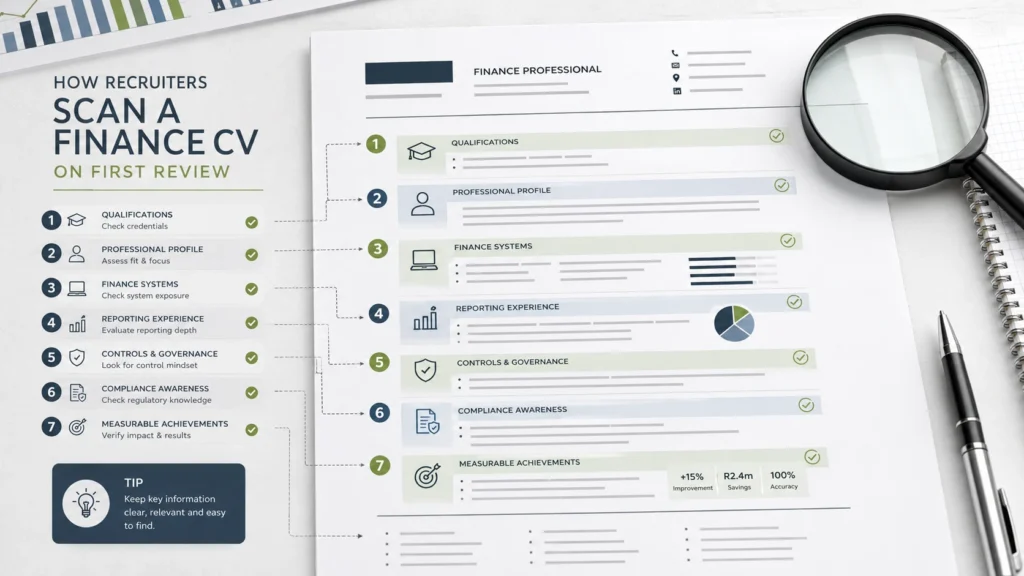
Recruiters do not read a finance CV in the same way they read a general administrative or operational CV. They are usually scanning for signs that you can be trusted with financial information, deadlines, controls, systems and business-critical reporting. They also want to see whether your experience matches the level and type of finance role they are recruiting for.
A strong finance CV therefore needs to answer two questions quickly: “Can this person do the technical work?” and “Can this person add value at the level we need?”
Technical finance knowledge
Technical knowledge is usually one of the first things recruiters look for. This may include financial accounting, management accounting, bookkeeping, payroll, audit, tax, budgeting, forecasting, cost control, variance analysis, reconciliations or financial modelling.
Your CV should make this knowledge visible in the right places. Do not rely on recruiters to infer it from your job title. If you have prepared management accounts, supported annual financial statements, handled VAT submissions, reviewed reconciliations, built forecasts or worked on audit files, say so clearly.
Qualifications also matter. Depending on your level, recruiters may look for a finance-related degree, diploma, articles, CA(SA), SAIPA, CIMA, CGMA, tax qualifications, payroll certifications or other relevant study. If a qualification is important for your target role, it should not be hidden near the end of the CV.
Reporting, compliance and controls
Finance roles often involve deadlines, governance and accountability. Recruiters therefore look for evidence that you understand reporting cycles, compliance requirements and internal controls. This is especially important for accounting, payroll, tax, audit, financial management and senior finance roles.
For example, a payroll candidate may need to show PAYE, UIF, EMP201 or EMP501 exposure. An accountant may need to show VAT, reconciliations, month-end close and audit preparation. A finance manager may need to show reporting packs, budgets, forecasts, controls, cash-flow management and audit readiness. For tax, payroll and finance operations roles, experience with SARS business and employer tax obligations may be relevant.
The more regulated, senior or commercially sensitive the role, the more important it becomes to show that you can work accurately, protect confidential information and support sound decision-making.
Systems, data and stakeholder communication
Finance recruiters often scan for systems before they read the full detail of your experience. A clear systems section can therefore make your CV much easier to assess. Include relevant ERP, accounting, payroll, spreadsheet and reporting tools such as SAP, Oracle, Sage, Pastel, Xero, QuickBooks, Syspro, Microsoft Dynamics, Excel, Power Query, Power Pivot or Power BI.
However, systems experience should not sit in isolation. Where possible, connect tools to business use. For example, did you use Excel to build forecasting models, Power BI to improve reporting visibility, Sage or Pastel for bookkeeping, SAP for reconciliations, or payroll software to process salaries accurately and on time?
Stakeholder communication is also important. Finance professionals rarely work only with numbers. They support managers, auditors, clients, suppliers, executives, operations teams, HR, sales teams and external advisors. Your CV should show whether you can explain financial information clearly, resolve queries, challenge assumptions and support better business decisions.
Achievements and measurable impact
One of the biggest weaknesses in many finance CVs is that they describe responsibilities but not results. Recruiters may see phrases such as “responsible for month-end reporting”, “handled reconciliations” or “managed creditors”, but they do not always see evidence of quality, scale or impact.
A stronger finance CV shows what improved because of your work. This could include reducing reporting turnaround time, improving reconciliations, lowering overdue debt, strengthening controls, supporting a clean audit, improving forecast accuracy, reducing costs, automating a manual process or giving senior stakeholders better visibility of financial performance.
Not every finance achievement needs to include a dramatic rand value. You can also use reporting frequency, transaction volumes, portfolio size, team size, audit outcomes, deadline improvements, error reductions, process improvements or stakeholder scope. If you need a broader framework, this guide can help you turn finance duties into achievements.
| Recruiter checks | What your finance CV should show |
|---|---|
| Qualifications | Degree, diploma, articles, CA(SA), SAIPA, CIMA, CGMA, payroll, tax or other relevant study |
| Technical knowledge | Financial accounting, management accounting, bookkeeping, payroll, audit, tax, FP&A or commercial finance exposure |
| Reporting | Management accounts, statutory accounts, board packs, variance analysis, cash-flow reporting or year-end reporting |
| Compliance | VAT, PAYE, UIF, EMP201, EMP501, tax submissions, audit files, policies, controls or regulatory reporting |
| Systems | SAP, Oracle, Sage, Pastel, Xero, QuickBooks, Syspro, Dynamics, Excel, Power BI or payroll systems |
| Accuracy and controls | Reconciliations, audit readiness, error reduction, process checks, segregation of duties or risk controls |
| Stakeholder value | Business partnering, EXCO reporting, client liaison, supplier queries, operations support or management reporting |
| Achievements | Savings, faster reporting, improved controls, cleaner audits, reduced debt, better forecasts or stronger decision support |
| Sector exposure | Financial services, retail, manufacturing, FMCG, logistics, public sector, professional services or multinational environments |
| Career level | Graduate, clerk, bookkeeper, accountant, manager, business partner, controller, head of finance or CFO-track experience |
The aim is not to overload your CV with every possible finance phrase. The aim is to make the right evidence easy to find. A recruiter should be able to scan your CV and quickly understand your level, technical fit, systems background, commercial relevance and measurable contribution.
The best structure for a finance CV
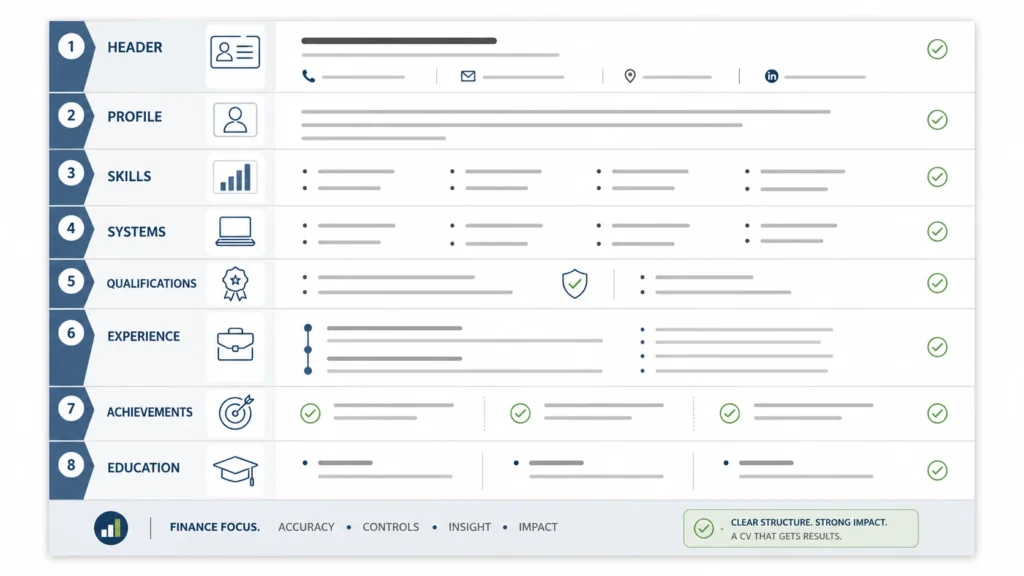
A finance CV should be easy to scan, logically ordered and focused on evidence. Recruiters should not have to search through long paragraphs to find your qualifications, systems, reporting experience or achievements. The structure should help them understand your level, technical fit and value within the first few moments of reading.
| Finance CV section | Purpose |
|---|---|
| Header | Makes your contact details easy to find |
| Professional profile | Summarises your level, specialism and value |
| Key finance skills | Matches recruiter and ATS screening |
| Technical systems | Shows the tools and platforms you can work with |
| Qualifications | Establishes professional credibility |
| Professional experience | Shows role scope, duties, level and progression |
| Key achievements | Proves measurable impact |
| Education, certifications and extras | Supports your technical and professional profile |
1. Header and contact details
Your header should be clean and simple. Include your name, mobile number, email address, LinkedIn URL and general location, such as Johannesburg, Cape Town, Durban, Pretoria or “South Africa” if you are open to remote or international opportunities.
Avoid overloading the top of your CV with unnecessary personal information. In most cases, you do not need to include your full residential address, ID number, marital status, dependants or other sensitive details at first application stage unless the employer has specifically requested them. Because a CV contains personal information, it is sensible to be selective about what you share and remain mindful of privacy principles overseen by the Information Regulator.
2. Professional profile
Your professional profile should be a short, focused summary of who you are as a finance professional. Aim for four to six lines. It should state your level, finance specialism, sector exposure, technical strengths and the kind of value you bring.
For example, a financial accountant might focus on month-end reporting, reconciliations, audit preparation, IFRS exposure and ERP systems. A finance business partner might focus on forecasting, margin analysis, stakeholder engagement and commercial decision support. A senior finance leader might focus on governance, strategy, cash flow, board reporting and performance improvement.
Avoid generic wording such as “hard-working, reliable and detail-oriented”. These qualities matter, but they are stronger when proven through the rest of the CV.
3. Key finance skills
A key skills section helps recruiters and ATS systems quickly identify whether your CV matches the role. Keep it targeted. Do not list every finance term you know. Instead, choose skills that reflect your real experience and the job you are applying for.
Useful finance skills may include:
- Financial reporting
- Management accounts
- Statutory accounts
- Month-end and year-end close
- Budgeting and forecasting
- Variance analysis
- Cash-flow management
- Reconciliations
- Audit preparation
- VAT, PAYE and tax compliance
- Payroll processing
- Internal controls
- Business partnering
- Financial modelling
- Cost analysis
- Board or EXCO reporting
4. Technical systems
Finance recruiters often look for systems experience early. A separate technical systems section can therefore be useful, especially if your target roles mention specific ERP, accounting, payroll or reporting platforms.
Include systems such as SAP, Oracle, Sage, Pastel, Xero, QuickBooks, Syspro, Microsoft Dynamics, Excel, Power Query, Power Pivot, Power BI, payroll software and any industry-specific reporting tools. Where possible, connect systems to the work you performed. For example, “Advanced Excel for forecasting models” is stronger than simply listing “Excel”.
5. Qualifications and professional memberships
Finance qualifications should be easy to find. If your qualification is central to the role, place it near the top of the CV rather than hiding it after your employment history.
Depending on your background, this section may include a degree, diploma, honours degree, articles, CA(SA), SAIPA membership, CIMA or CGMA studies, payroll certification, tax qualifications, short courses or in-progress study. For accounting credibility, you may reference professional bodies such as SAICA or SAIPA where relevant. For management accounting and commercial finance pathways, the CIMA qualification may also be important.
Be clear about whether a qualification is complete, in progress or planned. Do not make recruiters guess.
6. Professional experience
Your experience section should usually be reverse chronological, starting with your most recent role. For each position, include your job title, employer, dates and a concise description of the business or finance environment if it helps explain the scale of your role.
Then explain your responsibilities in a way that shows level and scope. For example, instead of writing “handled reports”, explain whether you prepared monthly management accounts, statutory reports, board packs, audit files, forecasts, cash-flow reports or divisional performance packs.
If your experience is strong but difficult to organise clearly, CV writing support for finance professionals can help you structure the document around level, evidence and target roles.
7. Key achievements
Finance achievements are especially powerful because they show evidence. They help recruiters see not only what you were responsible for, but what improved because of your work.
Where possible, include numbers. These may include rand values, percentage improvements, reporting deadlines, debtor book size, transaction volumes, portfolio size, team size, audit outcomes, cost savings, process improvements or forecast accuracy. If figures are confidential, use scale without exposing sensitive data.
Examples of finance achievement areas include:
- Reduced month-end reporting time
- Improved reconciliation accuracy
- Decreased overdue debt
- Supported a cleaner audit process
- Improved cash-flow visibility
- Built dashboards or reporting packs
- Strengthened controls
- Automated manual reporting tasks
- Improved budget or forecast quality
- Supported cost reduction or margin improvement
8. Education, certifications and optional extras
Education and certifications should support your professional story. For graduates, this section may sit higher on the CV because academic evidence is often one of the strongest selling points. For experienced professionals, it can usually sit after experience unless the qualification is a key requirement.
Optional extras may include professional development, relevant memberships, languages, selected publications, board involvement, volunteer finance responsibilities or industry training. Only include extras if they support your target role.
Your LinkedIn profile should also reinforce the same positioning, especially if recruiters compare it with your CV. It may be worth taking time to align your LinkedIn profile with your finance CV.
If you are not sure whether your current structure is helping or hurting your applications, you can get a free CV review before making further changes.
Finance CV keywords South African recruiters and ATS systems may scan for
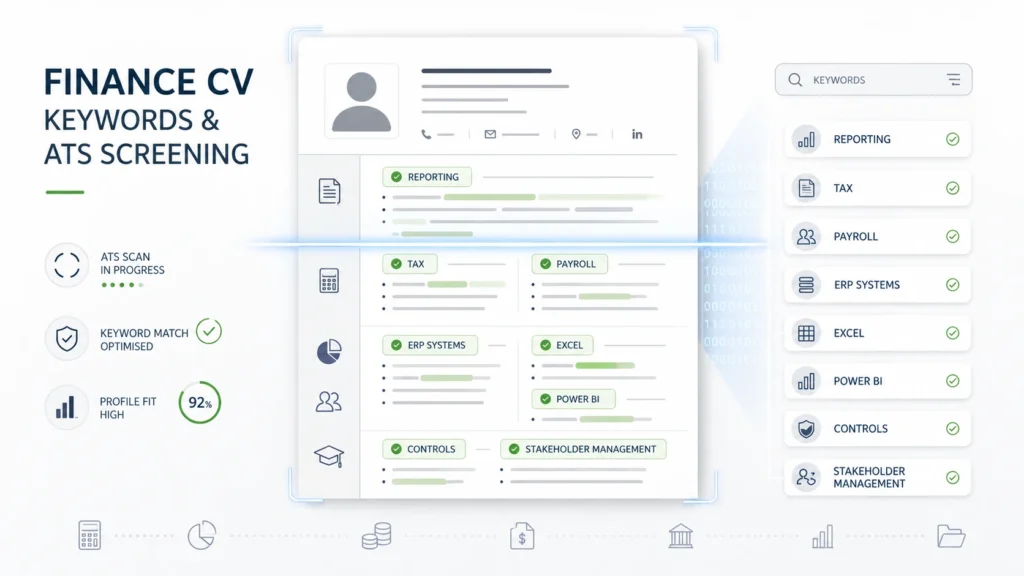
Keywords matter because recruiters, hiring managers and applicant tracking systems often scan for specific experience before reading the full document in detail. If the right terms are missing, your CV may look less relevant than it really is.
However, finance CV keywords should be used carefully. The aim is not to stuff your CV with every accounting, tax, audit or reporting phrase you can think of. The aim is to make your genuine experience easy to find.
Why finance CV keywords matter
A recruiter working on a financial accountant role may search for IFRS, reconciliations, audit files, month-end close, VAT, SAP or annual financial statements. A finance business partner role may be screened for forecasting, variance analysis, business partnering, Power BI, margin analysis or stakeholder management. A payroll role may be filtered for PAYE, UIF, EMP201, EMP501, payroll processing or payroll reconciliations.
This is why your finance CV should use language that matches both your experience and the roles you are targeting. If your CV only says “responsible for reporting”, it may not show enough relevance. If it says “prepared monthly management accounts, variance analysis and cash-flow reports for senior management”, it becomes clearer and more searchable.
For more detail on formatting, parsing and screening systems, read this guide to CV keywords and ATS screening.
Finance CV keyword examples by category
The table below gives examples of finance CV keywords that may be useful, depending on your role and actual experience. You should not include every term. Choose the keywords that honestly reflect what you have done and what your target roles require.
| Keyword category | Examples to consider |
|---|---|
| Financial reporting | IFRS, annual financial statements, statutory reporting, group reporting, board packs, financial statements, financial reporting packs |
| Budgeting / forecasting | Budget preparation, rolling forecasts, cash-flow forecasting, scenario planning, budget variance, forecast accuracy |
| Management accounts | Month-end close, management accounts, variance analysis, management reporting, cost analysis, departmental reporting |
| Statutory accounts | AFS, year-end reporting, audit files, audit schedules, reconciliations, statutory reporting |
| Audit | Internal audit, external audit, audit packs, working papers, audit findings, controls testing, audit readiness |
| Tax | VAT, PAYE, income tax, provisional tax, tax compliance, SARS submissions, tax reconciliations |
| Compliance | Governance, policies, risk, regulatory reporting, internal controls, compliance monitoring, financial controls |
| Payroll | Payroll processing, payroll reconciliations, EMP201, EMP501, UIF, leave reconciliations, payroll reporting |
| ERP / accounting systems | SAP, Oracle, Sage, Pastel, Xero, QuickBooks, Syspro, Microsoft Dynamics, NetSuite |
| Excel / BI | Advanced Excel, pivot tables, VLOOKUP/XLOOKUP, Power Query, Power Pivot, Power BI, dashboards, financial modelling |
| Stakeholder management | EXCO reporting, board reporting, operations support, business partnering, supplier liaison, client liaison, management reporting |
| Commercial finance | Margin analysis, pricing, profitability, cost optimisation, revenue analysis, performance reporting, decision support |
| Controls / risk | Reconciliations, segregation of duties, process improvement, fraud prevention, risk controls, control testing |
| Cash flow / treasury | Cash-flow forecasting, working capital, liquidity, banking, funding, debtor management, creditor management |
| Debtors / creditors | Credit control, collections, debtor book, creditors reconciliations, supplier payments, age analysis |
| Sector exposure | Financial services, retail, FMCG, manufacturing, logistics, public sector, professional services, multinational group |
How to use keywords without keyword stuffing
Finance keywords work best when they appear naturally in the right sections of the CV. They can be used in your professional profile, key skills section, technical systems section and professional experience. The experience section is especially important because it proves that the keyword is connected to real work.
For example, it is weak to list “forecasting” as a standalone skill if the CV gives no evidence of forecasting experience. It is stronger to write that you “supported rolling forecasts by consolidating departmental inputs, analysing variances and preparing commentary for senior management.”
The same applies to systems. Listing SAP, Sage, Pastel, Xero or Power BI can help, but it is stronger when you explain how you used those systems. Did you process invoices, produce dashboards, review reconciliations, manage payroll, prepare reports, clean data or support month-end close?
Use finance CV keywords effectively by:
- Matching your CV to the job advert without copying it word for word
- Using only keywords that reflect your genuine experience
- Placing important terms near the top of the CV where appropriate
- Including a dedicated systems section if tools are important in your target roles
- Showing keywords in context inside your experience section
- Using achievements to prove the quality, scale or impact of your work
- Avoiding long keyword lists that are not backed up by evidence
A well-keyworded finance CV should still read naturally. The best test is whether a recruiter can quickly understand your level, technical fit, systems background and value without feeling as if the CV has been written only for software.
Finance CV advice by role and career level
Not every finance CV should be written in the same way. A graduate finance CV should not look like a finance manager CV. An audit CV should not read exactly like an FP&A CV. A senior finance leadership CV should show more than technical accounting ability.
The best finance CVs are targeted by role level, specialism and career direction. The sections below explain what to prioritise depending on where you are in your finance career.
Graduate finance CV
A graduate finance CV needs to prove potential. You may not have years of finance experience yet, but you can still show academic strength, technical knowledge, motivation and evidence that you are ready for a professional finance environment.
Lead with your qualification, academic focus, relevant modules, projects, internships, articles, vacation work, Excel ability and any exposure to accounting or finance systems. If you have completed a dissertation, group project, case study, financial analysis assignment or business simulation, include it where relevant.
You can also include part-time work, student leadership, society treasurer roles, tutoring, volunteering or administrative work if it shows accuracy, responsibility, customer service, deadlines, cash handling or numerical ability.
For a graduate finance CV, consider including:
- Degree, diploma, honours or relevant finance qualification
- Relevant modules such as accounting, tax, auditing, economics, statistics or financial management
- Academic projects involving analysis, reporting or financial interpretation
- Articles, internships, vacation work or job shadowing
- Excel, accounting software or data analysis exposure
- Student leadership or treasurer responsibilities
- Part-time work that shows reliability, accuracy or customer service
- A clear target role or career direction
If you are trying to land your first finance role, you can also use this broader graduate CV guidance for South African candidates.
Accountant CV
An accountant CV should show technical competence, reporting reliability and the ability to work accurately under pressure. Recruiters will often look for month-end close, reconciliations, general ledger work, VAT, tax exposure, audit preparation, financial statements, accounting systems and deadlines.
Your CV should make it clear what type of accounting environment you have worked in. For example, have you supported a single entity, multiple branches, group companies, SMEs, professional services clients, retail operations, manufacturing sites or a multinational business? This context helps recruiters understand the scale of your experience.
Avoid writing broad statements such as “responsible for accounting duties”. Instead, be specific. Mention management accounts, bank reconciliations, balance sheet reconciliations, intercompany accounts, creditors, debtors, fixed assets, VAT returns, audit schedules, financial reporting packs or annual financial statements where relevant.
An accountant CV should usually highlight:
- Month-end and year-end reporting
- Reconciliations and general ledger accuracy
- VAT, PAYE, tax or SARS-related exposure where relevant
- Audit file preparation and auditor liaison
- Financial statements or reporting packs
- Accounting software and ERP systems
- Process improvements or control enhancements
- Reporting deadlines, entity size or transaction volume
Finance manager CV
A finance manager CV needs to show ownership. At this level, recruiters are not only assessing whether you can prepare reports. They want to see whether you can manage deadlines, lead people, improve controls, support decision-making and keep the finance function running effectively.
Your CV should show the scope of your role. Include team size, reporting lines, turnover or budget exposure where appropriate, number of entities or branches, sector context, systems environment and whether you reported to a CFO, Financial Director, CEO, EXCO or board.
Strong finance manager CVs often include evidence of better reporting, cleaner audits, improved cash-flow visibility, stronger controls, reduced overdue debt, faster month-end close, improved forecasting, cost savings or successful system/process changes.
For a finance manager CV, prioritise:
- Team leadership and staff development
- Management accounts, board packs or EXCO reporting
- Budgets, forecasts and cash-flow management
- Audit readiness and year-end delivery
- Internal controls and governance
- Working capital, debtors and creditors oversight
- Process improvement and system implementation
- Stakeholder engagement with senior management
Finance business partner CV
A finance business partner CV should be more commercial than transactional. It needs to show that you can interpret financial data, challenge assumptions, explain performance and help non-finance stakeholders make better decisions.
This means your CV should focus on decision support, not only reporting. Include evidence of variance analysis, forecasting, margin analysis, profitability, pricing, cost optimisation, performance dashboards, business cases, scenario planning and operational stakeholder engagement.
It is also important to show the audience you supported. For example, did you partner with sales, operations, supply chain, manufacturing, retail, regional managers, project teams, executives or business unit leaders? The stronger the stakeholder context, the easier it is for recruiters to understand your commercial influence.
A finance business partner CV should highlight:
- Forecasting, budgeting and performance analysis
- Variance commentary and business recommendations
- Margin, pricing, profitability or cost analysis
- Stakeholder engagement with non-finance teams
- Dashboards, reporting packs or Power BI insight
- Business cases and scenario planning
- Commercial decision support
- Evidence of influencing outcomes, not just producing reports
For management accounting and commercial finance pathways, the CIMA qualification may be especially relevant, depending on your career route and target roles.
Audit and tax CV
An audit CV should show technical knowledge, client or sector exposure, risk awareness and the ability to work with evidence. Recruiters may look for audit planning, working papers, audit findings, controls testing, IFRS exposure, client liaison, audit files and deadlines.
It is useful to show the type of audits you have supported. For example, include whether you worked with SMEs, listed entities, public sector clients, financial services, manufacturing, retail, non-profits or multinational groups. Also mention whether your work involved external audit, internal audit, risk reviews, compliance testing or controls improvement.
A tax CV should show accuracy, compliance and advisory ability. Depending on your role, include VAT, PAYE, income tax, provisional tax, SARS submissions, tax reconciliations, objections, disputes, tax planning, corporate tax or individual tax exposure.
For audit and tax CVs, useful evidence may include:
- Audit planning and fieldwork
- Working papers and supporting schedules
- Internal controls and risk testing
- Audit findings and recommendations
- Client or stakeholder liaison
- IFRS, statutory reporting or compliance exposure
- VAT, PAYE, income tax or provisional tax
- SARS submissions, reconciliations or dispute support
Senior finance leadership CV
A senior finance leadership CV should not read like a long technical accounting CV. Technical credibility still matters, but the emphasis should shift towards leadership, governance, commercial performance, risk, strategy and organisational impact.
For CFO-track, Head of Finance, Financial Controller, Group Finance Manager or Finance Director roles, your CV should show how you have influenced business performance. This may include cash-flow management, funding, cost optimisation, financial transformation, M&A support, ERP implementation, board reporting, governance, risk management, audit committee exposure or multi-entity leadership.
At senior level, scale matters. Include turnover, budget responsibility, team size, geographic scope, number of entities, reporting lines, board or EXCO exposure and sector context where this information is not confidential. If figures are sensitive, use sensible ranges or descriptive scale.
Governance exposure can also matter for CFO-track and senior finance leadership roles, especially where board, audit committee or listed-company reporting is involved. South African senior leaders may need to understand current governance expectations, including the King V corporate governance report.
A senior finance leadership CV should usually show:
- Strategic finance leadership
- Board, EXCO or audit committee reporting
- Governance, risk and controls
- Cash flow, funding or working capital leadership
- Business transformation or ERP implementation
- M&A, restructuring or growth support
- Team leadership across finance functions
- Commercial impact on profitability, cost, revenue or performance
- Multi-entity, group or international exposure where relevant
If you are preparing a senior finance leadership CV, this executive CV guidance may also help you think about positioning, evidence and strategic value.
If you are targeting a senior, confidential or international finance move, you can speak about your next finance move before deciding how to position your CV.
Finance CV examples: turning duties into stronger achievements
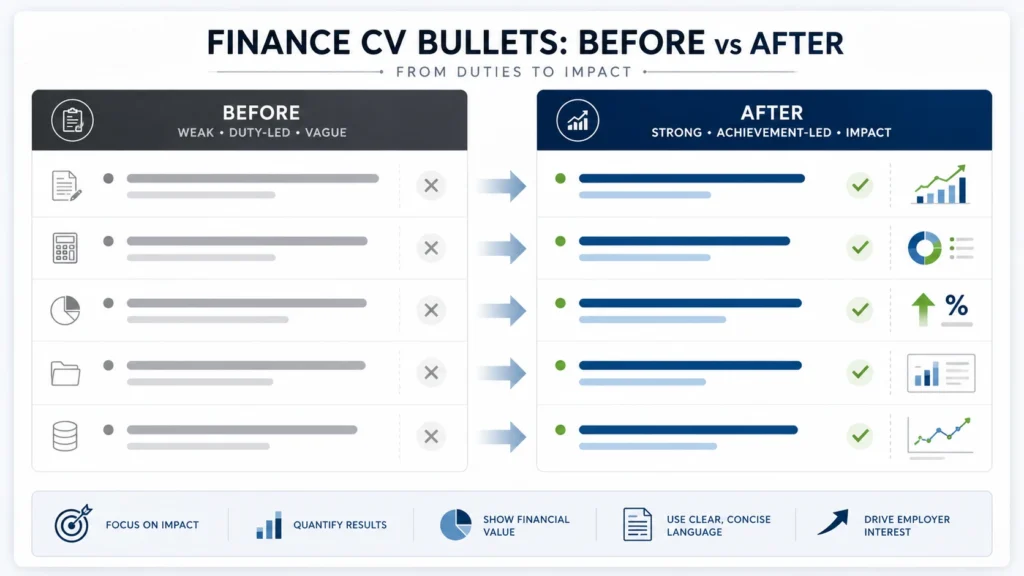
One of the easiest ways to strengthen a finance CV is to rewrite duty-led bullet points as achievement-led bullet points. Many finance professionals have good experience, but their CVs undersell them because the wording only describes what they were responsible for.
A weak bullet often starts with phrases such as “responsible for”, “assisted with”, “handled” or “involved in”. These phrases are not always wrong, but they can make your work sound passive or routine. A stronger bullet shows the scope of the work, the action you took and the value or outcome.
Why achievement-led bullets work better
Finance recruiters want evidence. They need to understand whether you can work accurately, meet deadlines, improve processes, support compliance, manage reporting cycles and contribute to better financial decisions.
That does not mean every bullet needs a dramatic rand value. In many finance roles, useful evidence can include reporting frequency, deadline improvement, debtor book size, transaction volume, audit outcome, number of entities, team size, stakeholder level, systems used or process improvements.
If exact figures are confidential, you can still show scale without disclosing sensitive information. For example, you might refer to a multi-entity group, high-volume creditors process, national branch network, monthly EXCO pack, large debtor book or time-sensitive payroll environment.
Before and after finance CV bullet examples
| Weak finance CV bullet | Stronger achievement-led version |
|---|---|
| Responsible for monthly management accounts. | Prepared monthly management accounts for a multi-branch operation, improving reporting turnaround and giving senior managers clearer variance commentary. |
| Handled debtors and creditors. | Managed high-volume debtors and creditors processes, improving reconciliations, reducing overdue items and supporting cleaner month-end reporting. |
| Assisted with audits. | Prepared audit schedules and supporting documentation, helping reduce audit queries and improve year-end file quality. |
| Completed VAT and PAYE submissions. | Supported accurate VAT and PAYE submissions, maintaining compliance deadlines and resolving discrepancies before submission. |
| Prepared budgets and forecasts. | Supported annual budgeting and rolling forecasts, consolidating input from departments and improving visibility of cost pressures. |
| Did bank reconciliations. | Completed bank reconciliations across multiple accounts, identifying discrepancies early and supporting accurate month-end close. |
| Worked on payroll. | Processed payroll inputs and reconciliations in a deadline-driven environment, helping ensure accurate employee payments and statutory submissions. |
| Created reports in Excel. | Built Excel-based reporting trackers that improved visibility of costs, outstanding items and monthly finance deadlines. |
| Managed finance team. | Led a finance team through month-end, audit preparation and reporting deadlines, improving workflow discipline and accountability. |
| Reported to management. | Prepared financial performance commentary for senior management, translating variances and cost movements into practical business insights. |
How to write stronger finance CV bullets
A practical way to improve your finance CV is to use a simple structure: action, scope and outcome.
For example:
- Action: Prepared, managed, reconciled, reviewed, improved, automated, analysed, reduced, supported, implemented or led
- Scope: Monthly accounts, payroll, VAT, debtor book, audit file, reporting pack, forecast, budget, team, division or system
- Outcome: Faster reporting, improved accuracy, better controls, fewer queries, cleaner audit files, reduced overdue debt or stronger decision support
A basic duty might say: “Responsible for reconciliations.” A stronger version might say: “Reviewed monthly balance sheet reconciliations across multiple accounts, resolving discrepancies earlier and improving the quality of month-end reporting.”
Another basic duty might say: “Prepared forecasts.” A stronger version might say: “Consolidated departmental inputs for rolling forecasts, highlighting cost pressures and helping senior managers make earlier budget decisions.”
The goal is not to exaggerate. The goal is to make the value of your work clearer. A finance CV should still be accurate, credible and grounded in facts.
If your CV still reads like a list of responsibilities, you can request free CV feedback before rewriting the whole document.
Common finance CV mistakes to avoid
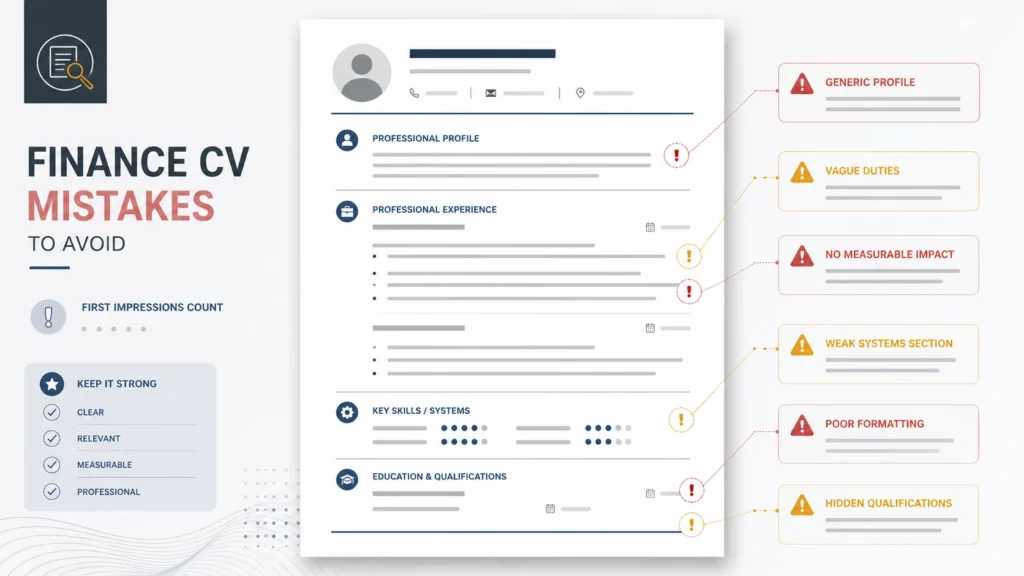
Even experienced finance professionals can weaken their applications with CV mistakes that are easy to miss. The issue is not usually a lack of experience. More often, the CV fails to show the right evidence clearly enough.
These are some of the most common CV mistakes to avoid when writing a finance CV.
Mistake 1: Listing duties only
A finance CV that only lists duties can make strong experience sound ordinary. Phrases such as “responsible for reports”, “handled accounts” or “assisted with month-end” do not show scale, quality or impact.
Instead, explain what you worked on, how often, at what level and what improved. For example, mention whether you prepared monthly management accounts, reduced reporting delays, improved reconciliations, supported audit readiness or gave senior managers clearer financial insight.
Mistake 2: Hiding qualifications
Finance qualifications matter. If your degree, diploma, articles, CA(SA), SAIPA membership, CIMA studies, payroll certification or tax qualification is important for the role, do not bury it near the end of the CV.
Place key qualifications where recruiters can find them quickly. This is especially important for accounting, audit, tax, finance manager and senior finance roles where qualifications may be part of the screening criteria.
Mistake 3: Using vague “attention to detail” claims
“Attention to detail” is one of the most common phrases in finance CVs, but on its own it does not prove much. Almost every finance candidate says it.
A stronger CV proves attention to detail through evidence. Mention accurate reconciliations, reduced errors, clean audit files, deadline-sensitive payroll, improved controls, reviewed reporting packs or resolved discrepancies before submission.
Mistake 4: Weak systems section
Many finance roles are system-driven. If your CV does not show your ERP, accounting, payroll, Excel or BI experience clearly, recruiters may assume your systems exposure is weaker than it is.
Create a clear technical systems section if systems are important for your target roles. Include tools such as SAP, Oracle, Sage, Pastel, Xero, QuickBooks, Syspro, Microsoft Dynamics, Excel, Power Query, Power Pivot, Power BI or payroll software where relevant.
Mistake 5: No measurable impact
Finance CVs become more persuasive when they include measurable evidence. This does not mean every bullet needs a rand value. It means recruiters should see the scale and value of your work.
Use figures where possible, such as reporting deadlines, transaction volumes, debtor book size, portfolio size, number of entities, team size, audit outcomes, turnaround times, cost savings, improved forecast accuracy or reduced overdue debt.
Mistake 6: Overloading the CV with technical jargon
Technical language is important, but too much jargon can make a CV hard to read. This is especially risky when your CV may be reviewed first by a recruiter, HR professional or business leader before it reaches a finance hiring manager.
Use finance terminology where it adds clarity, but balance it with plain explanations of scope, stakeholders and outcomes. A strong finance CV should be technically credible and easy to understand.
Mistake 7: Poor ATS formatting
Overdesigned CVs can create problems. Tables, icons, graphics, text boxes, columns and unusual formatting may look attractive, but they can make the CV harder for applicant tracking systems to read.
For most finance roles, a clean structure is safer. Use clear headings, simple formatting, standard section labels and role-relevant keywords. If you are unsure how to structure your CV for screening systems, this guide to an ATS-optimised CV structure may help.
Mistake 8: Not tailoring by role type
A finance CV should not be identical for every application. An accountant CV, finance business partner CV, audit CV and finance manager CV need different emphasis.
For example, an accountant CV may focus on reconciliations, month-end, VAT and audit files. A finance business partner CV should highlight forecasting, variance analysis, commercial decision support and stakeholder engagement. A senior finance CV should show leadership, governance, board reporting, risk, strategy and commercial impact.
Finance CV mistakes checklist:
- Duties with no results
- Qualifications buried too low
- Generic professional profile
- No clear systems section
- No measurable achievements
- Too much unexplained technical jargon
- Poor ATS formatting
- Same CV sent to every finance role
- Weak evidence of controls, compliance or accuracy
- Little connection between finance work and business impact
If several of these issues appear in your current CV, a free finance CV review can help you identify the highest-impact changes first.
Should you use a finance CV template?
A finance CV template can be useful if it gives you a clean structure and helps you organise your information. It can show you where to place your profile, skills, systems, qualifications, experience and education. For graduates or early-career finance candidates, a template can also make the writing process feel less overwhelming.
However, a template will not decide what matters most in your career. It will not know whether your CV should emphasise accounting, audit, tax, payroll, FP&A, commercial finance, finance management or senior leadership. It also will not know which achievements, systems, qualifications or role-specific keywords will matter most for the jobs you are targeting.
When a finance CV template helps
A template can help when your current CV has no clear order, inconsistent formatting or missing sections. It can also help you avoid overly informal layouts, long unbroken paragraphs and unclear headings.
A useful finance CV template should:
- Use clear section headings
- Keep contact details simple
- Include a focused professional profile
- Make qualifications easy to find
- Include a key skills section
- Include a technical systems section
- Present experience in reverse chronological order
- Leave enough space for achievement-led bullet points
- Avoid unnecessary graphics, icons and decorative design
- Work for both recruiters and applicant tracking systems
For most finance roles, clean and simple is better than heavily designed. Recruiters usually want to find your technical fit quickly. They are less interested in visual decoration than in whether your CV clearly shows the right experience, systems, qualifications and evidence.
When a finance CV template becomes a problem
A template becomes a problem when it makes your CV look neat but does not improve the content. This is common when finance professionals copy a generic layout but still use vague wording, duty-led bullet points and weak achievements.
Another issue is overdesign. Some templates use columns, icons, text boxes, graphics, rating bars or unusual formatting. These may look attractive, but they can make the CV harder to scan and may create problems with ATS parsing.
A finance CV should not rely on design to create impact. The impact should come from clear positioning, relevant keywords, strong evidence and measurable achievements.
For example, a template might give you a space for “key achievements”, but it cannot write a strong achievement for you. It will not automatically turn “responsible for reconciliations” into “Reviewed monthly balance sheet reconciliations across multiple accounts, resolving discrepancies earlier and improving month-end reporting quality.”
That is why many finance candidates need tailored content more than a new layout. The structure matters, but the wording, evidence and targeting matter more.
If you are comparing templates, AI tools and professional support, this guide to choosing a CV writing company in South Africa may help you decide what level of support is appropriate.
In short, a finance CV template can help you organise the document. It cannot replace clear thinking about your target role, your strongest evidence and the specific finance value you bring.
When to get professional help with a finance CV
You may not need professional help if your finance CV is already clear, well structured, achievement-led and targeted to the roles you want. However, if you are sending applications and not getting the response you expected, the issue may not be your experience. It may be how that experience is being presented.
Professional support can be useful when your CV is too task-based, too technical, too long, too generic or difficult to align with your next career move. This is especially common for finance professionals who have worked across multiple roles, sectors, systems or levels of responsibility.
You may benefit from professional finance CV support if:
- You have strong experience but your CV reads like a list of duties
- You are applying for finance manager, financial manager or senior finance leadership roles
- You are moving from accounting into commercial finance, FP&A or business partnering
- You are changing sector or applying internationally
- You need to explain complex finance, audit, tax or systems experience clearly
- You are not sure which achievements to include
- Your LinkedIn profile does not match your CV positioning
- You need your CV, LinkedIn profile and cover letter to work together
- You are applying for confidential or senior roles and need careful positioning
Brendan Hope CV Writing provides professional CV writing support for South African finance professionals, as well as LinkedIn profile optimisation and tailored cover letter support.
For senior, sensitive or more complex career moves, you can also book a confidential call to discuss how your finance CV should position your leadership, commercial value and next-step direction.
Finance CV FAQs
What should a finance CV include?
A finance CV should include your contact details, professional profile, key finance skills, technical systems, qualifications, professional experience, achievements, education and relevant certifications. It should also make your finance specialism clear, whether that is accounting, bookkeeping, payroll, audit, tax, FP&A, finance management, business partnering or senior finance leadership.
The most important point is evidence. Your CV should not only say what you were responsible for. It should show the level you worked at, the systems you used, the reporting or compliance exposure you had, and the measurable value you delivered.
How long should a finance CV be in South Africa?
Most South African finance CVs should be around two pages if the candidate has early-career or mid-level experience. Senior finance professionals may need three pages if they have complex leadership experience, multiple roles, board exposure, major achievements, systems projects or international experience.
Length is less important than relevance. A two-page CV filled with vague duties is weaker than a well-structured three-page CV with strong evidence. However, avoid padding. Every section should help the reader understand your fit for the role.
Should I include a photo on my finance CV?
In most cases, a photo is not necessary on a finance CV unless it is specifically requested by the employer or recruiter. Finance hiring decisions should be based on your qualifications, technical skills, experience, credibility and achievements.
A clean, professional CV without a photo is usually safer, especially if you are applying through online systems or for roles where privacy, fairness and objectivity are important.
Should I include my ID number on a South African finance CV?
Usually, you do not need to include your ID number on your CV at first application stage unless the employer specifically requests it. Your CV will already contain personal information, so it is sensible to avoid adding unnecessary sensitive details too early in the process.
You can provide required identity, verification or compliance information later in the recruitment process when there is a clear reason and a trusted process for handling it.
What skills should I include on a finance CV?
The best skills to include depend on your target role. Common finance CV skills include financial reporting, reconciliations, management accounts, statutory accounts, budgeting, forecasting, VAT, PAYE, audit preparation, tax compliance, payroll, cash-flow management, internal controls, Excel, ERP systems and stakeholder management.
For commercial finance, FP&A or finance business partner roles, include skills such as variance analysis, margin analysis, pricing, profitability, Power BI, dashboard reporting, scenario planning and decision support. For senior finance roles, include governance, risk, board reporting, team leadership, transformation and strategic finance leadership.
How do I write achievements for a finance CV?
To write stronger finance CV achievements, use a simple structure: action, scope and outcome. Start with what you did, explain the scale or context, and then show what improved.
For example, instead of writing “responsible for reconciliations”, you could write: “Reviewed monthly balance sheet reconciliations across multiple accounts, resolving discrepancies earlier and improving the quality of month-end reporting.”
Useful achievement evidence may include cost savings, reduced reporting time, improved reconciliations, cleaner audit files, lower overdue debt, better cash-flow visibility, improved forecast accuracy, stronger controls or more useful management reporting.
What keywords should I use in a finance CV?
Use keywords that match your real experience and the roles you are targeting. Common finance CV keywords include IFRS, management accounts, statutory accounts, reconciliations, month-end close, annual financial statements, VAT, PAYE, SARS submissions, audit files, budgeting, forecasting, payroll, SAP, Sage, Pastel, Xero, Excel, Power BI and internal controls.
Do not add keywords only because they sound impressive. Recruiters and hiring managers will expect to see evidence of those skills in your experience section. If you want more detail on screening systems, this guide to CV keywords and ATS screening may help.
How should a graduate write a finance CV?
A graduate finance CV should lead with potential, technical knowledge and evidence of readiness for a finance environment. If you have limited work experience, include your qualification, relevant modules, academic projects, internships, articles, vacation work, Excel skills, accounting software exposure, student leadership and part-time work where relevant.
Do not apologise for being early in your career. Instead, show what you have already done that proves accuracy, reliability, analytical ability, commercial interest and willingness to learn. This may include academic finance projects, case studies, society treasurer responsibilities, tutoring, admin work or customer-facing roles involving cash handling and deadlines.
How do I tailor a finance CV for international roles?
If you are applying for international finance roles, make your qualifications, role level and technical experience easy to understand. Use internationally recognised finance language where possible, such as IFRS, financial reporting, management accounts, statutory reporting, budgeting, forecasting, audit, internal controls, ERP systems and stakeholder reporting.
You may also need to explain South African context where it helps. For example, clarify professional designations, articles, local tax exposure or sector experience if an international recruiter may not immediately understand it. Keep the CV factual, clear and focused on transferable finance value.
Do I need a different CV for accountant, finance manager and finance business partner roles?
Yes, in most cases. The same finance background can be positioned differently depending on the target role. An accountant CV should usually emphasise reporting, reconciliations, month-end, tax, audit files and accounting systems. A finance manager CV should show ownership, controls, deadlines, leadership, cash flow, budgets and senior stakeholder reporting.
A finance business partner CV should be more commercial. It should highlight forecasting, variance analysis, business cases, performance insight, margin analysis, pricing, dashboards and stakeholder influence. Sending the same CV to all three role types can weaken your applications because the emphasis may not match the vacancy.
Can Brendan Hope CV Writing help with a finance CV?
Yes. Brendan Hope CV Writing supports South African finance professionals with CV writing, LinkedIn profile optimisation, cover letters, job-search strategy, interview preparation and career coaching.
If your finance CV feels too task-based, too technical, too long or not targeted enough, you can get a free CV review. For more structured support, professional CV writing support is also available.
If you are applying for a finance role that needs a supporting letter, you can also strengthen your application with a finance cover letter.
Get feedback on your finance CV
A strong finance CV should make your value clear quickly. It should show more than tasks. It should prove your accuracy, reporting ability, systems strength, compliance awareness, commercial judgement and measurable business impact.
If your current CV feels too task-based, too technical or not targeted enough for the roles you want, you can get a free CV review from Brendan Hope CV Writing.
For senior, confidential or more complex career moves, you can also book a free intro call to discuss how your finance CV should position your experience, leadership and next-step direction.